CLBufferRead
CLBufferRead
Reads an OpenCL buffer into an array and returns the number of read elements.
uint  CLBufferRead(
   int          buffer,                    // A handle to the OpenCL buffer
   const void&  data[],                    // An array of values
   uint         buffer_offset=0,           // An offset in the OpenCL buffer in bytes, 0 by default
   uint         data_offset=0,             // An offset in the array in elements, 0 by default
   uint         data_count=WHOLE_ARRAY     // The number of values from the buffer for reading, the whole buffer by default
   );
There are also versions for handling matrices and vectors.
Reads the OpenCL buffer to the matrix and returns true if successful.
uint  CLBufferRead(
   int           buffer,                    // a handle to the OpenCL buffer
   uint          buffer_offset,             // an offset in the OpenCL buffer in bytes
   const matrix& mat,                       // the matrix for receiving the values from the buffer
   ulong         rows=-1,                   // the number of rows in the matrix
   ulong         cols=-1                    // the number of columns in the matrix
   );
Reads the OpenCL buffer to the vector and returns true if successful.
uint  CLBufferRead(
   int           buffer,                    // a handle to the OpenCL buffer
   uint          buffer_offset,             // an offset in the OpenCL buffer in bytes
   const vector& vec,                       // the vector for receiving the values from the buffer
   ulong         size-1,                    // vector length
   );
Parameters
- buffer
[in] A handle of the OpenCL buffer.
- data[]
[in] An array for receiving values from the OpenCL buffer. Passed by reference.
- buffer_offset
[in] An offset in the OpenCL buffer in bytes, from which reading begins. By default, reading start with the very beginning of the buffer.
- data_offset
[in] The index of the first array element for writing the values of the OpenCL buffer. By default, writing of the read values into an array starts from the zero index.
- data_count
[in] The number of values that should be read. The whole OpenCL buffer is read by default.
- mat
[out] The matrix for reading data from the buffer can be any of the three types — matrix, matrixf or matrixc.
- vec
[out] The vector for reading data from the buffer can be of any of the three types — vector, vectorf or vectorc.
- rows=-1
[in] If the parameter is specified, the cols parameter should be specified as well. If the new matrix dimensions are not specified, the current ones are used. If the value is -1, then the number of rows does not change.
- cols=-1
[in] If the parameter is not specified, the rows parameter should be skipped as well. The matrix adheres to the rule: either both parameters are specified, or none, otherwise an error will occur. If both parameters (rows and cols) are specified, the matrix size is changed. In case of -1, the number of columns does not change.
- size=-1
[in] If the parameter is not specified or its value is -1, the vector length does not change.
Return Value
The number of read elements. 0 is returned in case of an error. For information about the error, use the GetLastError() function.
true if a matrix or a vector is handled successfully, otherwise false.
Note
For one-dimensional arrays, the number of the element, into which writing of data into an OpenCL buffer begins, is calculated taking into account the AS_SERIES flags.
An array of two or more dimensions is presented as one-dimensional. In this case, data_offset is the number of elements that should be skipped in the presentation, not the number of elements in the first dimension.
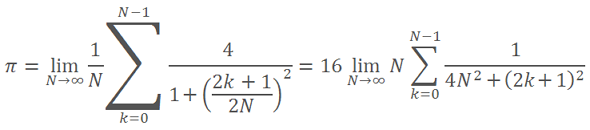
Example of calculating Pi using the equation:
#define  _num_steps        1000000000
#define  _divisor          40000
#define  _step             1.0 / _num_steps
#define  _intrnCnt         _num_steps / _divisor

//+------------------------------------------------------------------+
//|                                                                  |
//+------------------------------------------------------------------+
string D2S(double arg, int digits) { return DoubleToString(arg, digits); }
string I2S(int arg)                { return IntegerToString(arg); }

//--- OpenCL programm code
const string clSource=
  "#define _step "+D2S(_step, 12)+"                   \r\n"
  "#define _intrnCnt "+I2S(_intrnCnt)+"               \r\n"
  "                                                   \r\n"
  "__kernel void Pi( __global double *out )           \r\n"
  "{                                                  \r\n"
  "  int i = get_global_id( 0 );                      \r\n"
  "  double partsum = 0.0;                            \r\n"
  "  double x = 0.0;                                  \r\n"
  "  long from = i * _intrnCnt;                       \r\n"
  "  long to = from + _intrnCnt;                      \r\n"
  "  for( long j = from; j < to; j ++ )               \r\n"
  "  {                                                \r\n"
  "     x = ( j + 0.5 ) * _step;                      \r\n"
  "     partsum += 4.0 / ( 1. + x * x );              \r\n"
  "  }                                                \r\n"
  "  out[ i ] = partsum;                              \r\n"
  "}                                                  \r\n";

//+------------------------------------------------------------------+
//| Script program start function                                    |
//+------------------------------------------------------------------+
int OnStart()
 {
  Print("Pi Calculation: step = "+D2S(_step, 12)+"; _intrnCnt = "+I2S(_intrnCnt));
//--- prepare OpenCL contexts
  int clCtx;
  if((clCtx=CLContextCreate(CL_USE_GPU_ONLY))==INVALID_HANDLE)
   {
    Print("OpenCL not found");
    return(-1);
   }
  int clPrg = CLProgramCreate(clCtx, clSource);
  int clKrn = CLKernelCreate(clPrg, "Pi");
  int clMem=CLBufferCreate(clCtx, _divisor*sizeof(double), CL_MEM_READ_WRITE);
  CLSetKernelArgMem(clKrn, 0, clMem);

  const uint offs[1]  = {0};
  const uint works[1] = {_divisor};
//--- launch OpenCL program
  ulong start=GetMicrosecondCount();
  if(!CLExecute(clKrn, 1, offs, works))
   {
    Print("CLExecute(clKrn, 1, offs, works) failed! Error ", GetLastError());
    CLFreeAll(clMem, clKrn, clPrg, clCtx);
    return(-1);
   }
//--- get results from OpenCL device
  vector buffer(_divisor);
  if(!CLBufferRead(clMem, 0, buffer))
   {
    Print("CLBufferRead(clMem, 0, buffer) failed! Error ", GetLastError());
    CLFreeAll(clMem, clKrn, clPrg, clCtx);
    return(-1);
   }
//--- sum all values to calculate Pi
  double Pi=buffer.Sum()*_step;

  double time=(GetMicrosecondCount()-start)/1000.;
  Print("OpenCL: Pi calculated for "+D2S(time, 2)+" ms");
  Print("Pi = "+DoubleToString(Pi, 12));
//--- free memory
  CLFreeAll(clMem, clKrn, clPrg, clCtx);
//--- success
  return(0);
 }
  /*
  Pi Calculation: step = 0.000000001000; _intrnCnt = 25000
  OpenCL: GPU device 'Ellesmere' selected
  OpenCL: Pi calculated for 99.98 ms
  Pi = 3.141592653590
  */
//+------------------------------------------------------------------+
//| Auxiliary routine to free memory                                 |
//+------------------------------------------------------------------+
void CLFreeAll(const int clMem, const int clKrn, const int clPrg, const int clCtx)
 {
  CLBufferFree(clMem);
  CLKernelFree(clKrn);
  CLProgramFree(clPrg);
  CLContextFree(clCtx);
 }